
Your site will feel noticeably quicker when you take a clear approach to image delivery. Images made up almost half the weight of a typical page, so each visitor must fetch significant bytes even on slow connections.
Start with format and sizing choices. Modern formats such as AVIF and WebP cut file weight without visible loss of quality. Use responsive attributes like srcset and sizes, and consider a fallback to match each browser and device.
Defer non-essential work with lazy loading and decoding=”asynchronous” so above-the-fold content can load first. Define intrinsic width and height, or use CSS aspect-ratio, to avoid layout shifts and boost Core Web Vitals.
Plan caching and governance. Set Cache-Control headers and version files so returning users don’t re-download assets. Replace many raster icons with SVG to keep crisp visuals at small sizes.
Key Takeaways
- Images often dominate page weight; reduce bytes to improve perceived speed.
- Choose modern formats (AVIF/WebP) and use responsive delivery methods.
- Enable lazy loading and asynchronous decoding to prioritise visible content.
- Define dimensions or use aspect-ratio to prevent layout shifts.
- Use caching and file versioning so users don’t repeatedly download the same file.
Understand the goal: optimise website images for faster loading times
Shrinking file weight while keeping clear detail is the quickest way to make pages feel snappier.
Reduce transferred bytes without degrading perceived quality. That helps pages reach ~two seconds to load and improves visitor experience while saving hosting bandwidth.
Decide the right export choice before upload: use JPEG for photos, PNG for logos and detailed graphics, and GIF only when simple animation is needed. Resize each image to the display dimensions so you do not force the browser to fetch extra pixels.
Compress with reliable tools and set quality thresholds that still look sharp across devices. Consider progressive JPEGs to show a fast, recognisable preview while the full file arrives.
- Business impact: lower bandwidth and fewer hosting overages.
- Workflow: export → compress → verify → upload, and automate where possible.
| Format | Best use | Pros | Cons |
|---|---|---|---|
| JPEG | Photos | Small file at good quality; supports progressive scans | Lossy at high compression; not ideal for text or sharp lines |
| PNG | Logos, illustrations | Lossless with alpha channel; crisp lines | Larger file size for photos |
| GIF | Simple animation, tiny graphics | Wide support; small animated loops | Limited colours; poor for photos |
Benchmark current site speed to set a baseline
Before you alter media delivery, capture a clear baseline. Run tests across browsers, devices and throttled networks so your results reflect real users.
Reliable testing tools
Use PageSpeed Insights, WebPageTest, GTmetrix and Pingdom to get a rounded view. Each tool surfaces different issues and priorities.

Run each test more than once and note the settings (device type, connection throttling and date) so later comparisons are fair.
What to record
- Page weight and total image bytes — typical pages often include ~1 MB of images.
- Largest Contentful Paint (LCP) and Cumulative Layout Shift (CLS) to link media changes to user-centred metrics.
- Total requests by type and any render-blocking resources that delay page render.
- Which sizes and formats are used today, and any visible quality or compression artefacts.
Example target: reduce image bytes by 40% and reach LCP under 2.5 s.
| Metric | What to capture | Why it matters |
|---|---|---|
| Page weight | Total KB/MB | Shows dominant contributors to load and bandwidth cost |
| LCP | Seconds (desktop & mobile) | User-perceived load speed |
| CLS | Shift score | Visual stability for readers and shoppers |
Choose the right image format and delivery approach
Choose modern codecs first, then provide fallbacks to keep every browser happy.
AVIF and WebP deliver much smaller files without noticeable loss in quality. AVIF can cut file size by 50–70% versus JPEG in many cases. WebP enjoys broad support (96%+), making it a reliable choice for photos and complex art.
Use the <picture> element with type-based <source> tags to serve AVIF first, then WebP, and fall back to JPEG. This ensures each browser gets the best version available and keeps your site resilient.
When to keep older formats
Reserve PNGs for transparency and flat-colour graphics. GIFs are limited to 256 colours and should be rare; prefer animated WebP/AVIF or short video where motion needs richer colour.
- Default to AVIF or WebP for photos and detailed visuals.
- Use progressive JPEG where compatibility or progressive rendering helps perception.
- Convert and compare with tools like Squoosh to check quality and size.
- Test across browsers and consider CDN-based negotiation to serve the best version at the edge.
| Asset type | Recommended format | Reason |
|---|---|---|
| Hero photos | AVIF → WebP → JPEG | Best size reduction with quality preservation and fallbacks |
| Logos & icons | SVG or PNG | Sharp lines and transparency; small file when vectorised |
| Simple animation | Animated WebP / short MP4 | Better colours and compression than GIF |
Serve responsive images with the right sizes
Let the browser choose the best file by giving it clear size and resolution cues. You should map rendered dimensions across breakpoints and produce matching variants so the browser never downloads excess pixels.
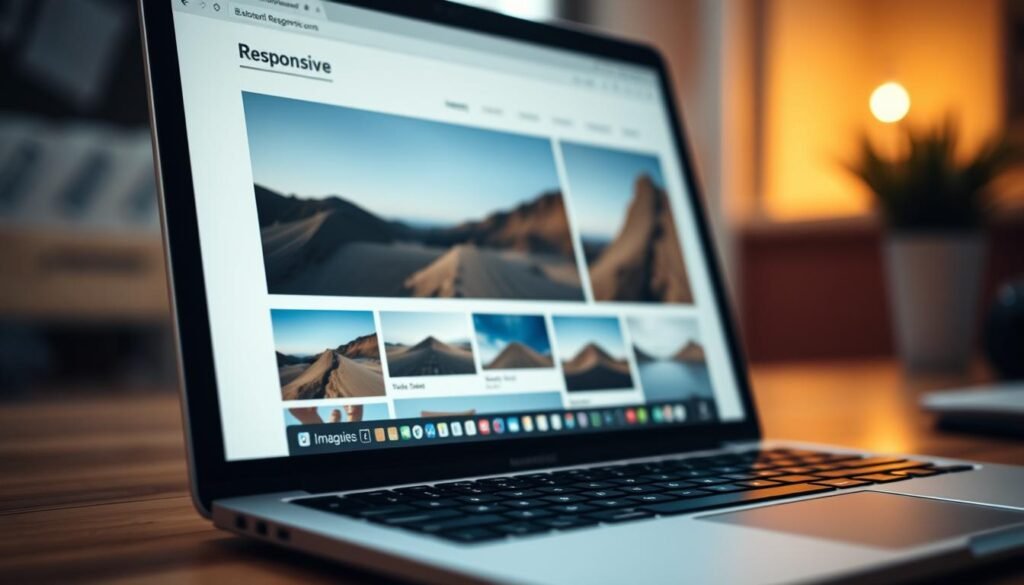
srcset and sizes to match user devices and screen resolutions
Use srcset with width descriptors (for example 400w, 800w, 1200w) and a sizes attribute that mirrors your CSS. A practical example is sizes="(max-width: 720px) 600px, 1200px". This tells the browser to pick a 600w asset on small viewports and a 1200w asset on larger ones.
Include density descriptors for key visuals. Offer 1x and 2x variants so high-DPI screens render crisp photos and icons without forcing huge bytes on smaller phones.
Practical breakpoints and density descriptors for crisp results
- Define breakpoints that match your CSS grid and components, not arbitrary numbers.
- Pair
<picture>for format fallbacks withsizeson the final<img>so format negotiation and responsive rules work together. - Keep icons and UI assets as SVG or explicitly small raster files to avoid oversized items.
- Test across browsers and devices to confirm the browser picks the intended candidate from the
srcsetlist.
Make variants that preserve visual quality at each resolution while minimising bytes on smaller viewports.
Organise files with consistent naming, folders and CDN paths so your asset pipeline stays maintainable. That way the right image is served reliably to every user and page.
Compress images effectively and automate where possible
Compression cuts bytes while keeping the visual look your visitors expect. Choose lossless when originals must be preserved and lossy when you can trade imperceptible detail for meaningful reductions in file size.
Desktop and web tools give you quick wins. TinyPNG applies smart lossy compression to PNGs and JPEGs. ImageOptim strips metadata on macOS and JPEGmini preserves perceived detail at aggressive ratios.
Automate in your workflow
Use WordPress plugins such as Imagify, EWWW Image Optimizer Cloud, TinyPNG and Kraken.io to compress on upload and bulk-process libraries. Check how each option handles CPU and API quotas so you do not overload hosting.
- Set default quality levels per format and spot-check product shots at each resolution.
- Include compression in CI/CD so every release contains preprocessed files.
- Monitor file size distribution and enforce max hero image size to prevent regressions.
| Use case | Recommended approach | Key benefit |
|---|---|---|
| Master assets | Lossless backups + compressed derivatives | Safe source and lean deliverables |
| Bulk site library | WordPress plugins or CDN transform | Automated, low-maintenance compression |
| High-res product shots | JPEGmini / manual checks | Preserved detail with smaller file size |
Practical rule: pick lossy where visual parity holds and keep lossless where edits or archive quality matter.
Improve loading behaviour in the browser
Cut initial work the browser must do by deferring non-essential visuals until the user reaches them.
Use lazy loading on assets that sit below the fold so the page fetches them only as the user scrolls. Add loading=”lazy” to those img tags and avoid lazy-loading key above-the-fold visuals to protect LCP.
Decode images asynchronously
Set decoding=”asynchronous” so the browser won’t block text and layout while a visual decodes. Try this across Chrome and Safari, then verify there are no visual flashes or colour shifts.
Reduce render work with content-visibility
Apply content-visibility: auto to heavy sections so the browser skips offscreen rendering. This reduces initial work and improves perceived performance on complex pages.
Practical rule: lazy load below-the-fold assets, keep heroes eager, and use async decoding plus content-visibility to lower initial render cost.
- Keep placeholders or aspect-ratio boxes to avoid layout shift.
- Audit and test lazy behaviour on touch and keyboard navigation.
- Centralise these controls in components so you can toggle behaviour per template.
| Feature | Action | Benefit |
|---|---|---|
| loading=”lazy” | Apply below the fold | Delays fetch until user scrolls near asset |
| decoding=”asynchronous” | Add to img tags | Prevents render-blocking decode |
| content-visibility | Set to auto on heavy sections | Skips offscreen rendering, reduces main-thread work |
Boost perceived speed with smart placeholders
Show visitors a recognisable preview immediately by serving a tiny, blurred placeholder that the browser swaps for the full asset. This reduces the blank-space effect and improves perceived page speed.
Blur-up and LQIP techniques to show a fast-loading preview
Blur‑up (LQIP) uses a very small, low‑resolution image or an encoded string such as BlurHash to show a soft preview. CDNs and many build tools can generate these placeholders automatically. Embed them inline or as a background so the user sees content immediately.
Progressive JPEGs: when to use and limitations
Progressive JPEGs give a coarse pass that sharpens without JavaScript. They are a useful option when you must support older browsers and keep markup simple.
- Prefer placeholders with modern formats (AVIF/WebP) rather than progressive scans.
- Reserve aspect‑ratio or CSS boxes to avoid layout shift during the swap.
- Test blur strength, colour and decode in multiple browsers to avoid artefacts.
- Keep alt text and semantics on the final img tag to preserve accessibility and SEO.
Practical rule: integrate placeholder generation into your build or CDN so editors do not add manual steps and you tune quality versus bytes per template.
Strengthen caching and layout stability
Robust cache headers paired with clear size hints keep your pages steady and reduce redundant downloads. Apply a consistent policy so the browser can store assets and avoid unnecessary repeat requests.
HTTP caching with Cache-Control headers and file versioning
Set Cache-Control headers such as Cache-Control: max-age=86400 to let browsers retain files for a predictable period.
- Long-lived TTLs for hashed filenames; short TTLs for mutable files.
- File versioning via content hashes or query strings so updates bypass caches.
- Validate rules at CDN, origin and any proxies so behaviour is consistent across the delivery chain.
- Monitor cache hit ratios and adjust TTLs to balance freshness with bandwidth savings.
Define image dimensions or aspect-ratio to reduce layout shift
Give the browser intrinsic width and height on each <img> wherever possible. That way the page reserves space before bytes arrive and prevents CLS.
When responsive layouts make fixed sizes impractical, apply aspect-ratio in CSS to preserve the element’s shape across breakpoints.
Practical checklist: cache hashed files aggressively, version assets on change, set intrinsic dimensions or aspect-ratio, and ensure placeholders are cacheable.
Measure impact: track repeat-download reduction and improved page responsiveness for returning users. Ensure critical icons and UI assets are cached so the site feels snappy and consistent to every user.
Conclusion
Wrap up the guide with clear actions you can follow on every project to keep images lean and reliable.
Start with a benchmark, pick AVIF/WebP fallbacks via <picture>, and add responsive srcset/sizes. Compress with tools like TinyPNG, ImageOptim or JPEGmini and automate in CI or via plugins such as Imagify or EWWW.
Use lazy loading and asynchronous decoding for below‑the‑fold assets, serve blur‑up placeholders, and set Cache‑Control with hashed versions to avoid repeat downloads. Track before/after metrics so stakeholders see speed and experience gains.
Quick action list: document sizes and cases, adopt an image‑aware CDN, schedule periodic audits, and keep testing as new content arrives. Find practical image delivery resources at image delivery resources.